Every January, rental property owners ask the same question: who is actually responsible for the 1099s? When a property manager collects rent, pays vendors, and sends owner distributions all year, the paperwork can feel like a mystery until a form lands in your mailbox, or doesn't. Many Boise owners only realize how much tracking is involved when a deadline is already close.
Knowing who files what helps you avoid missed deadlines and mismatched income reporting. In this blog, we will break down how 1099s work for Boise rental owners and how professional property management makes the process far simpler from January through December.
Key Takeaways
Property managers typically issue 1099-NEC forms to vendors and 1099-MISC forms to owners when payments meet the reporting threshold.
The reporting threshold rises from $600 to $2,000 for payments made in 2026, with those forms filed in early 2027.
Collecting W-9 forms and tracking payments by property all year prevents last-minute scrambling.
Organized bookkeeping gives owners and tax professionals clean records at filing time.
Why 1099 Forms Matter for Rental Owners
A 1099 is an information return that reports income or payments made outside of regular wages. For rental owners, two forms come up most often. The 1099-MISC reports rent paid to an owner, and the 1099-NEC reports payments to contractors for services.
These forms matter because the IRS compares them against what is reported on tax returns. A mismatch can trigger notices, delays, and unnecessary stress. The best way to prevent that is to keep records consistent from January through December rather than reconstructing them at tax time.
For owners with more than one property, the challenge grows quickly. Income, repairs, and vendor payments can overlap across addresses, and a single missing record can create confusion when it is time to file.
Who Sends 1099s to Vendors and Owners?
When a property manager collects rent and sends proceeds to an owner, the manager generally reports those payments on a 1099-MISC once they meet the threshold. The manager also issues a 1099-NEC to vendors, such as plumbers, electricians, and landscapers, who are paid for services above the threshold.
This is one of the biggest advantages of professional management. Because the manager pays vendors from owner funds, the manager usually handles vendor forms, including collecting a W-9 from each contractor before the first payment. Owners who pay vendors directly outside the management agreement may still be responsible for filing those forms themselves.
The threshold has also changed. Payments made in 2026 follow a new $2,000 limit, while 2025 payments still use the old $600 limit. Because thresholds can shift again, it is smart to confirm current rules with a tax professional each January.
How Vendor Payments Create Year-End Tax Paperwork
Every repair is also a payment, and payments add up. A single plumber who handles several calls across multiple properties can easily cross the reporting threshold by December. Without careful tracking, that total is easy to miss.
Working with a team that offers reliable maintenance coordination keeps vendor activity organized from the start. Each work order is documented, each vendor has paperwork on file, and each payment is logged against the correct property. That structure turns year-end reporting into a simple summary instead of a detective project.
Owners also benefit from fewer surprises. When every invoice is already categorized, it is easier to see which expenses are repairs, which are improvements, and which vendors need forms.
What Key Deadlines Owners Should Never Miss
Missing a filing date can lead to penalties, so it helps to know the calendar. The chart below shows the deadlines for forms covering 2026 payments.
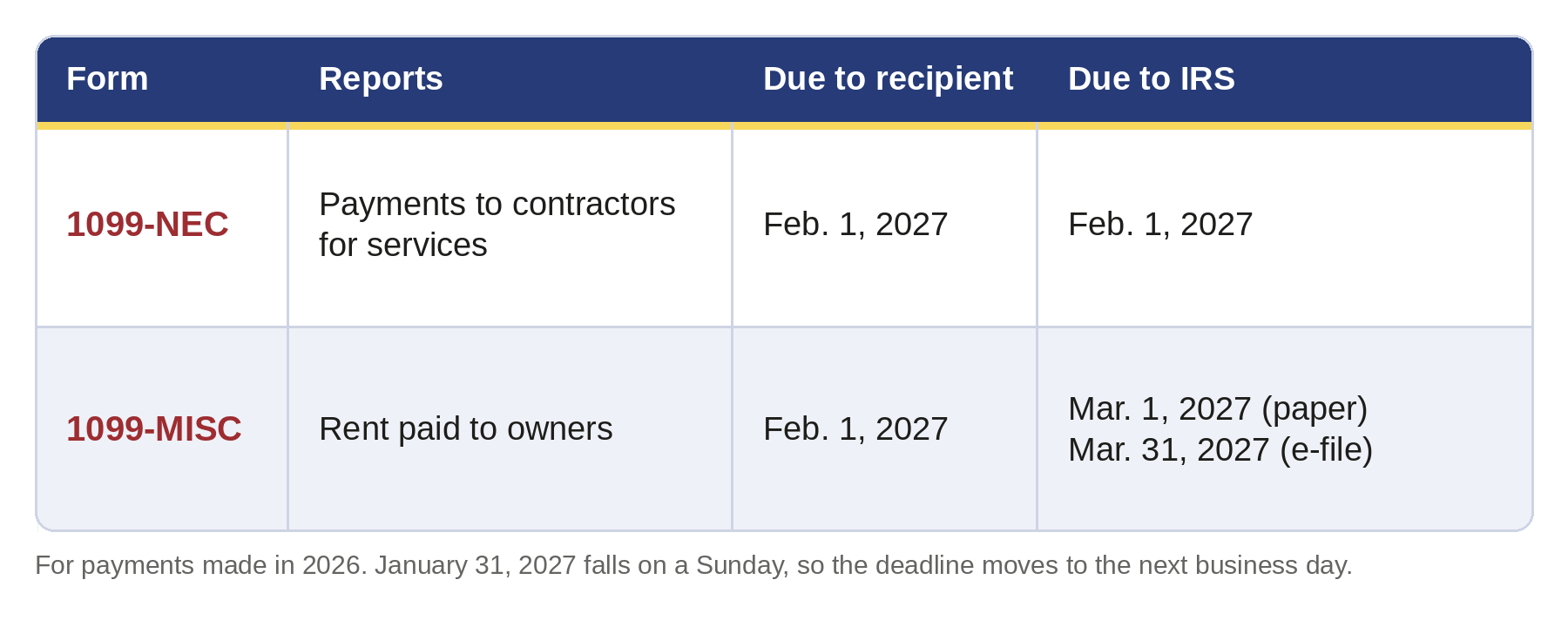
January 31, 2027 falls on a Sunday, which moves the deadline to the next business day. The 1099-NEC has no automatic extension, so timing matters. A property manager with a year-end routine already in place can meet these dates without last-minute pressure.
Owners should also expect to see these forms arrive close to the start of the year. If a form is missing or contains an error, such as a misspelled name or incorrect taxpayer number, contact your manager right away so a correction can be issued before filing.
Why Organized Bookkeeping Makes Tax Season Easier
Forms are only one piece of tax season. Owners also need accurate income and expense records to file their own returns. That is where consistent bookkeeping pays off.
Owners who rely on organized accounting services can log into a portal to view monthly statements, rent collected, and expenses sorted by property. Instead of digging through emails and receipts, you can hand a clean set of records to your accountant and move on.
Keep in mind that property managers prepare and deliver forms but do not provide tax advice. A qualified tax professional should guide decisions about deductions, depreciation, and how your rental income fits into your overall return. Strong records simply make that conversation faster and more accurate.
How Owners Can Prepare Before January Arrives
A smooth tax season starts well before the new year. Owners can take a few simple steps in the final months to avoid delays. Start by confirming that your mailing address and taxpayer information on file with your manager are current, since errors there are a common cause of corrected forms.
Next, review your year-to-date statements and look for any expenses or income that seem out of place. Catching a small issue in November is far easier than fixing it in February. Finally, schedule time with your tax professional early, because many accountants book quickly during filing season.
FAQs
Will my property manager send me a 1099?
Most property managers issue a 1099-MISC to owners when rent paid to them meets the reporting threshold.
Who issues 1099s to the vendors who repair my property?
When the manager pays vendors from your funds, the manager typically issues the 1099-NEC. Owners who pay vendors directly handle those forms on their own.
What is a W-9 and why do managers collect it?
A W-9 gives the manager a vendor's legal name and taxpayer identification number, which are needed to complete a 1099 correctly.
Do I still need an accountant if my manager sends forms?
Yes. Managers provide documents and records, while an accountant helps with deductions, depreciation, and overall tax planning.
When should I expect my 1099 forms?
Recipient copies are generally due by the end of January, or the next business day if that date falls on a weekend.
Partner With 1st Rate for a Stress-Free Tax Season
Tax season does not have to be a scramble for paperwork. With vendor documentation in place, payments tracked all year, and clear financial records, owners can approach filing with confidence instead of dread. The right management partner turns year-end reporting into a routine step.
If you want a Boise property manager who keeps your records organized from January to December, talk with our team at 1st Rate Property Management and see how a more organized tax season can work for you.